
 NO.718ANIME
OOTDBeatrix
NO.718ANIMEANIME OOTD / CHARACTER ARCHIVE
Beatrix
Final Fantasy IX ↗ / 2000
Alexandrian general and swordswoman
My figure room →







AI-assisted illustrations · Not official anime stills








Beatrix debuted in Final Fantasy IX in 2000 as a general serving Alexandria’s Queen Brahne. Initially a formidable opponent, she later becomes temporarily playable in specific story sequences, not a permanent freely selectable party member. Official merchandise confirms her character name and game design, but its release date does not replace her original debut.
Her confidence rests on real martial ability, but early on victory can appear to validate her judgment. As the harm caused by orders becomes harder to ignore, that certainty is challenged. Her change is not explained by simply calling her secretly gentle: acknowledging a flawed judgment and staying behind to protect others reveal more than composure alone.
Cleyra’s destruction and the danger to Garnet make obedience to the queen and protection of the kingdom impossible to treat as identical. She helps the party rescue the princess and remains with Steiner to hold enemies back, later aiding Alexandria’s defense and rebuilding. Becoming a protector does not erase earlier responsibility in war; that tension makes her story worth discussing.
Brahne is the queen she initially serves and Garnet later the ruler she protects; neither is her relative. Steiner captains another knight unit, with rivalry, cooperation and romance developing through the story, not an existing marriage at her debut. Freya confronts her in war; being paired in an official figure set does not make them a permanent in-story duo.
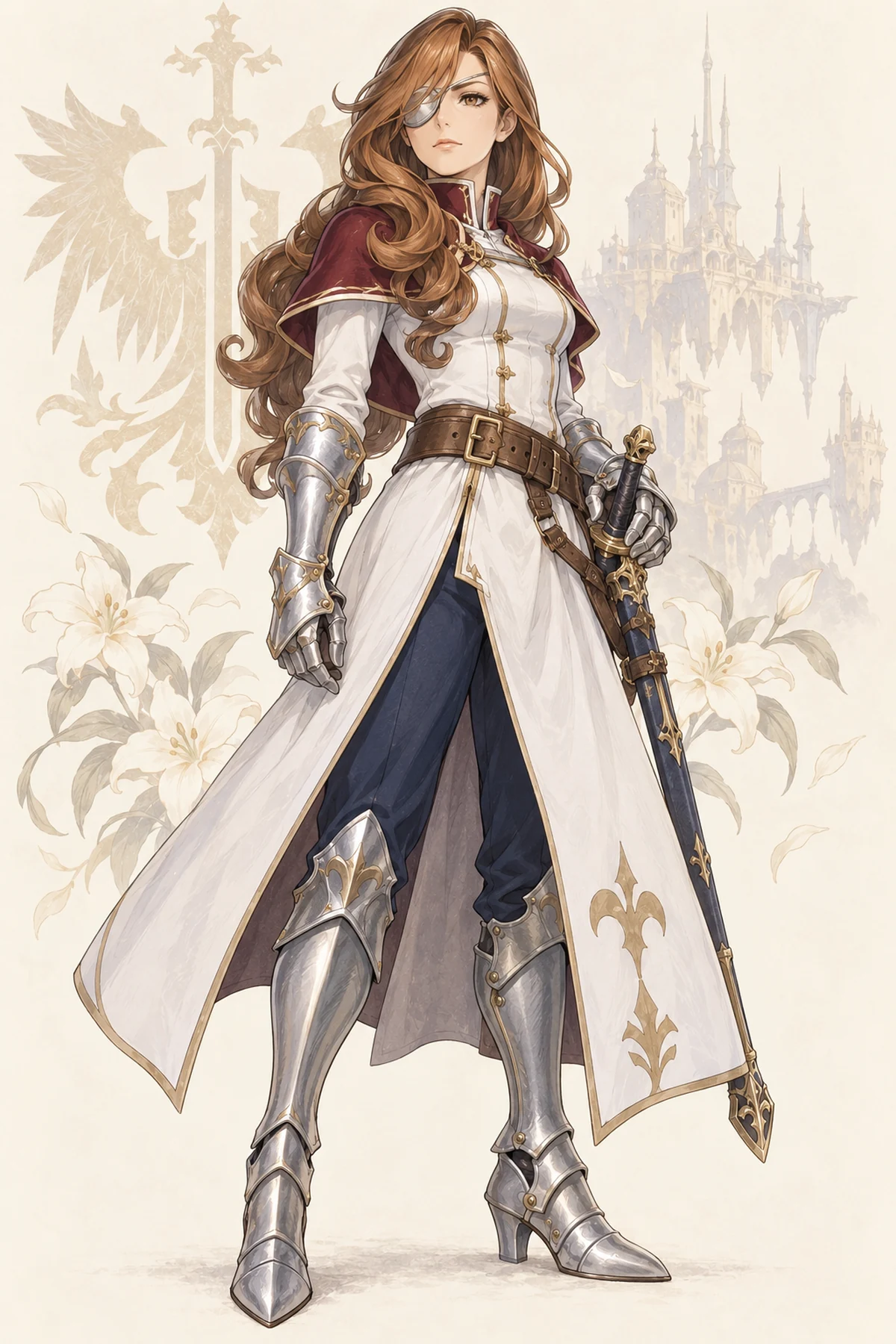
Chestnut curls, a gray patch over her right eye, white clothing, burgundy collar accents and metal gauntlets identify her. These fan images use a fully covering white long coat, dark trousers and silver armor as unofficial adaptations. The eyepatch does not establish an invented injury history. Photographic avatars are not actor photos, and transparent figures are display concepts rather than official merchandise.
Her turn asks more than how an enemy becomes an ally: when loyalty harms those it should protect, is admitting error part of knighthood? New actions must answer old choices, not merely replace a faction label. Her closeness to Steiner then includes both the comedy of misunderstandings and a renewed understanding of protection. This is interpretation of the story.